
If there’s one habit that can change how you age, it’s strength training. Not marathon running, not a fancy supplement. Lifting things, consistently, in a way that challenges your muscles.
After 50, muscle loss speeds up, bones get thinner and balance gets shakier. That’s what eventually makes everyday tasks like climbing stairs, carrying shopping or getting up from the floor harder. The good news is that muscles respond to training at any age, including in your 70s, 80s and beyond.
Key takeaways
- Muscle loss speeds up after 50, but muscles respond to training at any age.
- Two or three sessions a week of simple moves is enough to start.
- Add balance practice and enough protein, and make it a little harder over time.
In this article
Why muscle matters more as you age
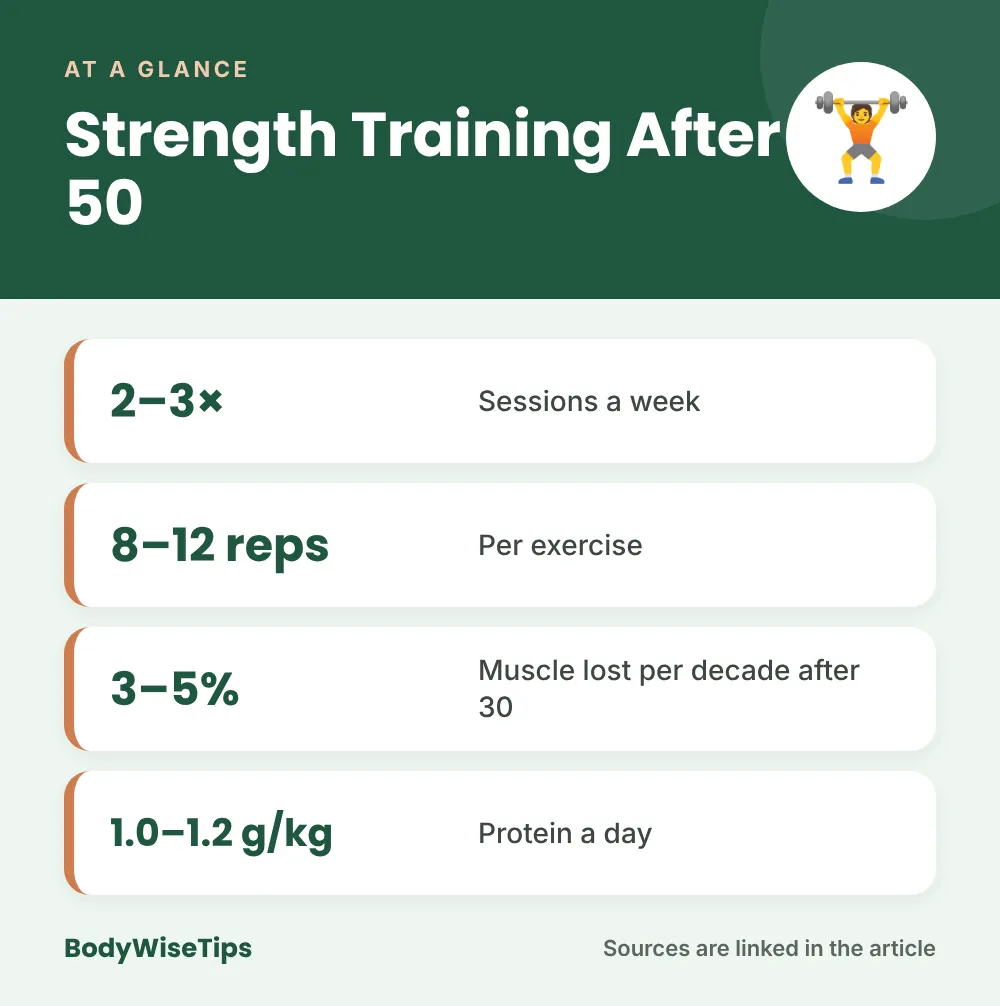
Starting in your 30s, you gradually lose muscle mass and strength, a process called sarcopenia when it becomes significant. Harvard Health notes that people can lose around 3 to 5% of their muscle mass per decade after 30, with the pace picking up later in life.
Losing muscle affects much more than appearance:
- Strength and independence. Muscle lets you get out of a chair, carry groceries and play with grandchildren.
- Falls. Weak legs and poor balance are major causes of falls, a leading cause of injury in older adults.
- Bones. Strength training puts healthy stress on bones, which helps slow bone loss and lower fracture risk.
- Blood sugar. Muscle is where much of your blood sugar goes. More muscle means better blood sugar control.
- Metabolism and weight. Muscle helps you burn more energy at rest.
- Mood and brain health. Resistance training is linked to better mood and may support thinking skills.
What the guidelines say
The CDC’s guidelines for older adults recommend:
- 150 minutes a week of moderate activity (like brisk walking)
- Muscle-strengthening activities on at least 2 days a week, working all major muscle groups
- Balance activities, such as standing on one foot or tai chi
Strength training is often the part people skip. It shouldn’t be.
Before you start
- Check with your doctor if you have heart disease, high blood pressure that isn’t controlled, recent surgery, osteoporosis, joint replacements or other ongoing conditions.
- Start lighter than you think. You can always add more.
- Consider a few sessions with a trainer or physical therapist to learn good form.
- Warm up with 5 minutes of walking or marching on the spot.
A beginner routine you can do at home
Do this two or three times a week, with at least one rest day between sessions. Start with 1 set of 8 to 12 reps of each exercise and build to 2 or 3 sets over a few weeks.
| Exercise | What it works | Easier version | Harder version |
|---|---|---|---|
| Sit-to-stand | Legs, hips | Use your hands on the chair arms | Hold a weight at your chest |
| Wall push-up | Chest, arms, shoulders | Stand closer to the wall | Push-up against a kitchen counter |
| Step-ups | Legs, balance | Low step, hold a rail | Higher step or hold weights |
| Bent-over row | Upper back, arms | Light weights or a water bottle | Heavier dumbbells or a resistance band |
| Glute bridge | Hips, lower back | Smaller range of motion | One leg at a time |
| Farmer’s carry | Grip, core, posture | Light bags, short distance | Heavier bags, longer walk |
| Calf raises | Calves, ankles, balance | Hold a counter with both hands | One hand, then no hands |
How heavy should it feel?
Choose a weight or version that makes the last two or three reps challenging but doable with good form. If you can easily do 15 or more, it’s time to make it harder. If you can’t do 8 with good form, make it easier.
This idea of gradually increasing the challenge is called progressive overload, and it’s what drives results.
Add balance work
Falls are a major risk after 50. Add a few minutes of balance practice:
- Stand on one foot for 10 to 30 seconds, holding a counter at first.
- Walk heel to toe in a straight line.
- Try tai chi or yoga classes.
The National Institute on Aging has free examples of strength, balance and flexibility exercises for older adults.
Feed your muscles
Training works best with enough protein. Older adults often benefit from about 1.0 to 1.2 grams of protein per kilogram of body weight per day, spread over meals. Include eggs, dairy, fish, chicken, beans, lentils or tofu at each meal. See our guide on how much protein you really need. If you’re considering a supplement, creatine has good evidence for helping strength when combined with training.
Common worries
“I’m too old to start.”
Studies have shown strength gains in people in their 80s and 90s. It’s never too late.
“I’ll hurt myself.”
Done with good form and sensible progression, strength training is safe for most people, and it actually lowers your risk of injury and falls over time. Pain in a joint (sharp or worsening) is a signal to stop and check, while normal muscle soreness a day or two later is expected.
“I have arthritis.”
Strength training often helps arthritis by supporting the joints. Start gently and talk to your doctor or physical therapist about the best exercises for you.
“I don’t have a gym.”
You don’t need one. Bodyweight exercises, resistance bands, water bottles and bags of groceries work fine to start.
Stop and get help if you feel
- Chest pain or pressure
- Severe shortness of breath
- Dizziness or faintness
- Sharp joint pain
It’s never too late to start
Strength training is one of the best things you can do for healthy aging. It protects muscle, bones, balance, blood sugar and independence. Start with simple exercises two or three times a week, make them gradually harder, add some balance work, and eat enough protein. Whether you’re 50 or 80, your muscles will respond.
Common questions
How long until I see results?
Many people feel stronger within four to eight weeks. Visible changes in muscle take longer.
Is walking enough exercise after 50?
Walking is excellent for your heart, but it doesn’t build much muscle. Combine it with strength training for the best results.
Should I lift weights if I have osteoporosis?
Strength training is often recommended for osteoporosis, but certain movements (like deep forward bending or twisting under load) may need to be avoided. Get guidance from your doctor or a physical therapist first.
Sources
- Preserve your muscle mass, Harvard Health Publishing.
- Older Adult Activity: An Overview, CDC.
- Exercise and Physical Activity, National Institute on Aging.
