
Every cold and flu season, the shelves fill up with products that promise to “boost” your immune system. Gummies, shots, powders, teas.
A slightly unpopular truth: you don’t actually want a boosted immune system. An immune system stuck in overdrive is what happens in allergies and autoimmune disease. What you want is an immune system that works well, reacts when it should and calms down when the job is done.
Harvard Health puts it plainly: the idea of boosting immunity is appealing, but the ability to do it with a product has proved hard to show. What does help is the everyday stuff. Below is what the research supports, roughly in order of how much it matters.
Key takeaways
- No food or pill “boosts” immunity. Daily habits are what keep it working well.
- Sleep, plants, protein, movement and less stress matter most.
- Handwashing and vaccines prevent more illness than any supplement.
In this article
- 1. Sleep enough, consistently
- 2. Eat plenty of plants (and enough protein)
- 3. Get your vitamin D checked if you rarely see the sun
- 4. Move most days
- 5. Manage long-term stress
- 6. Keep alcohol low and don’t smoke
- 7. Wash your hands and stay up to date on vaccines
- What about supplements?
- When to see a doctor
- No shortcuts, but plenty you can do
- Questions people ask
- Sources
1. Sleep enough, consistently
Sleep is where a lot of immune housekeeping happens. Short sleep is linked to a weaker response to infections and even to vaccines. In a well-known study published in the journal Sleep in 2015, people who slept less than six hours a night were more likely to catch a cold after being exposed to the virus than people who slept more than seven.
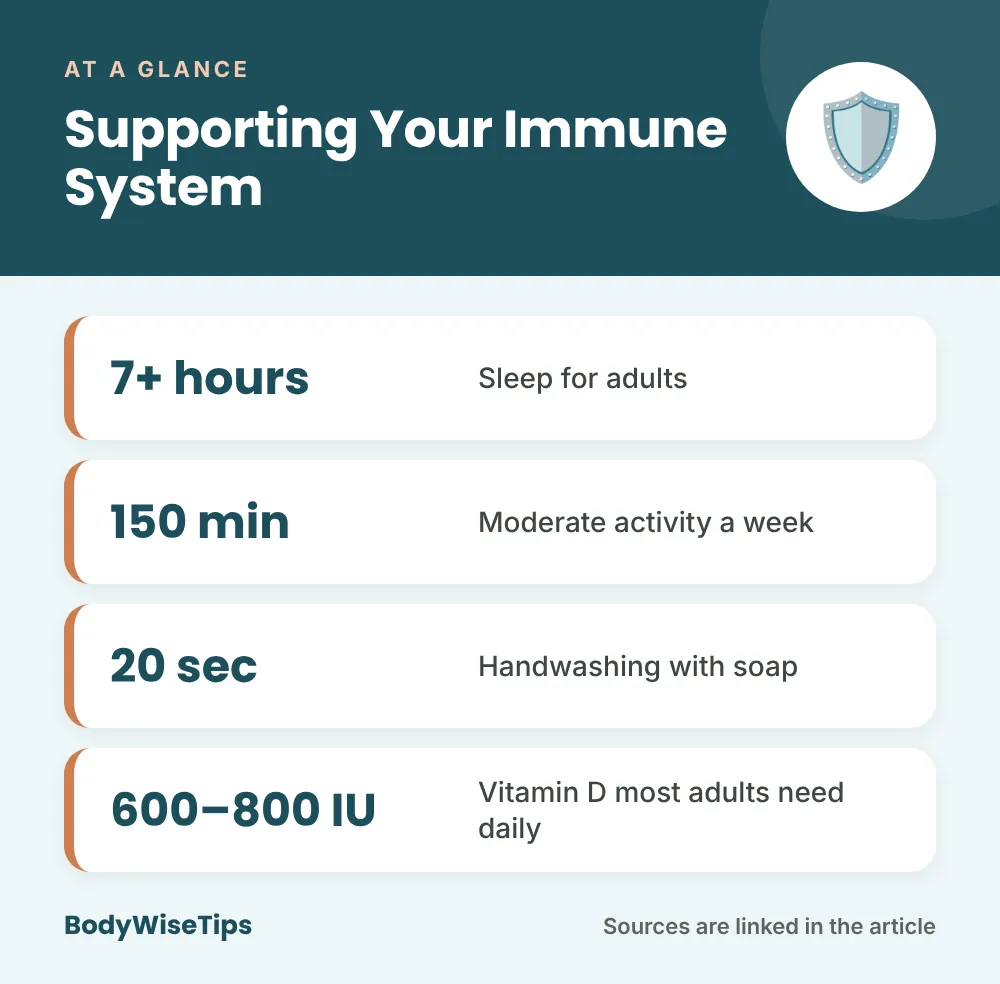
The CDC recommends at least seven hours a night for adults aged 18 to 60. If you struggle to get there, our guide on how to sleep better at night naturally is a good place to start.
2. Eat plenty of plants (and enough protein)
Your immune cells need a steady supply of nutrients to do their job. That doesn’t mean exotic superfoods. It means:
- Fruits and vegetables in a range of colors. They provide vitamin C, vitamin A, folate and plant compounds that support immune function.
- Enough protein. Antibodies and immune cells are built from protein. Beans, lentils, eggs, fish, chicken, yogurt and tofu all count.
- Fiber. Fiber feeds the bacteria in your gut, and your gut is home to a large part of your immune system. Whole grains, beans, oats and vegetables are the easiest sources.
3. Get your vitamin D checked if you rarely see the sun
Vitamin D plays a role in immune function, and low levels are common, especially in people with darker skin, people who cover most of their skin, and anyone who spends most of the day indoors. The NIH Office of Dietary Supplements lists 600 IU a day for most adults and 800 IU for those over 70.
Large analyses of clinical trials, including one published in the BMJ in 2017, suggest vitamin D supplements may slightly reduce the risk of respiratory infections, mainly in people who were low to begin with. More is not better: very high doses can be harmful. A simple blood test can tell you whether you need a supplement.
4. Move most days
Regular, moderate exercise is linked to fewer and milder respiratory infections. It also improves sleep and lowers stress, which helps immunity indirectly. You don’t need intense training. A brisk 30-minute walk on most days meets the basic adult guideline of 150 minutes a week from the CDC.
5. Manage long-term stress
Short bursts of stress are fine. Long-term stress keeps cortisol elevated, and over time that can dampen parts of the immune response. The American Psychological Association describes how chronic stress affects nearly every system in the body, including immunity.
Find what lowers your stress and make it a daily habit: a walk, prayer, a phone call with a friend, a few minutes of slow breathing.
6. Keep alcohol low and don’t smoke
Heavy drinking weakens the body’s ability to fight infections, including pneumonia, according to the National Institute on Alcohol Abuse and Alcoholism. Smoking damages the lining of your airways, which is one of your first lines of defense.
7. Wash your hands and stay up to date on vaccines
Not glamorous, but these two prevent more illness than any supplement. The CDC recommends washing with soap and water for at least 20 seconds, especially before eating and after using the bathroom. Vaccines train your immune system to recognize specific germs before you meet them, which is about as close to a real “boost” as exists.
What about supplements?
A quick look at the popular ones. None replaces the habits above.
| Supplement | What the evidence says |
|---|---|
| Vitamin C | Taken regularly, it may slightly shorten colds. It doesn’t prevent them for most people. |
| Vitamin D | May help people who are low. Get tested rather than guessing. |
| Zinc lozenges | Started early, they may shorten colds a little. Can cause nausea and a bad taste. |
| Probiotics | Some strains may help a little, but results vary. See NCCIH. |
| Elderberry, echinacea | Mixed, limited evidence. |
Check with a pharmacist before taking supplements if you take other medicines, are pregnant, or have a chronic condition.
When to see a doctor
Getting two to four colds a year is normal for adults. Talk to your doctor if you get infections much more often than that, if infections are unusually severe or slow to clear, or if you have a high fever that lasts more than a few days, trouble breathing or chest pain.
No shortcuts, but plenty you can do
There’s no shortcut. The habits that support your immune system are the same ones that support everything else: enough sleep, plenty of plants, regular movement, less stress, little alcohol, no smoking, clean hands and up-to-date vaccines. They aren’t exciting, but they work, and they don’t come with a monthly subscription.
Questions people ask
What is the fastest way to strengthen your immune system?
There isn’t a fast way. Getting proper sleep for a few nights in a row is probably the quickest change with a real effect.
Does gut health affect immunity?
Yes. A large share of immune cells live in and around the gut, and the gut bacteria interact with them closely. Eating more fiber is one of the most reliable ways to support a healthy gut.
Can exercise weaken your immune system?
Moderate exercise supports immunity. Very long, intense sessions without enough rest or food may temporarily lower it, which matters mostly for endurance athletes.
Sources
- How to boost your immune system, Harvard Health Publishing.
- About Sleep, Centers for Disease Control and Prevention.
- Vitamin D: Fact Sheet for Health Professionals, NIH Office of Dietary Supplements.
- Adult Activity: An Overview, CDC.
- Stress effects on the body, American Psychological Association.
- Alcohol’s Effects on the Body, National Institute on Alcohol Abuse and Alcoholism.
- About Handwashing, CDC.
- Probiotics: What You Need To Know, National Center for Complementary and Integrative Health.
- Prather AA, et al. Behaviorally assessed sleep and susceptibility to the common cold. Sleep. 2015;38(9):1353-1359.