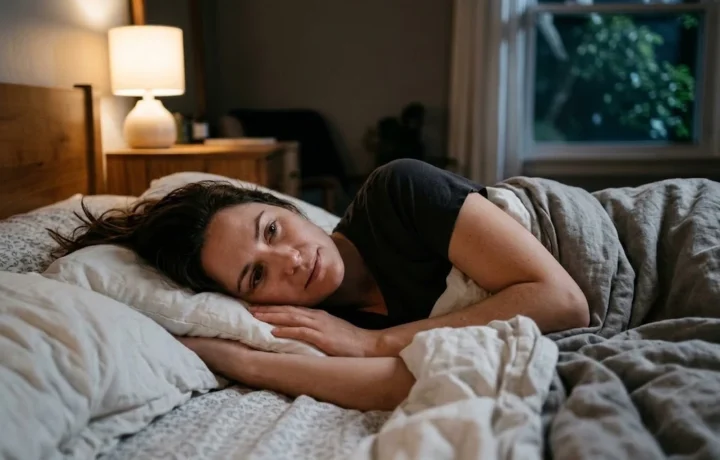
You go to bed tired. Then you lie there. Your mind replays a conversation from three days ago, you check the time, you calculate how many hours of sleep you’ll get if you fall asleep right now, and the pressure keeps you awake even longer.
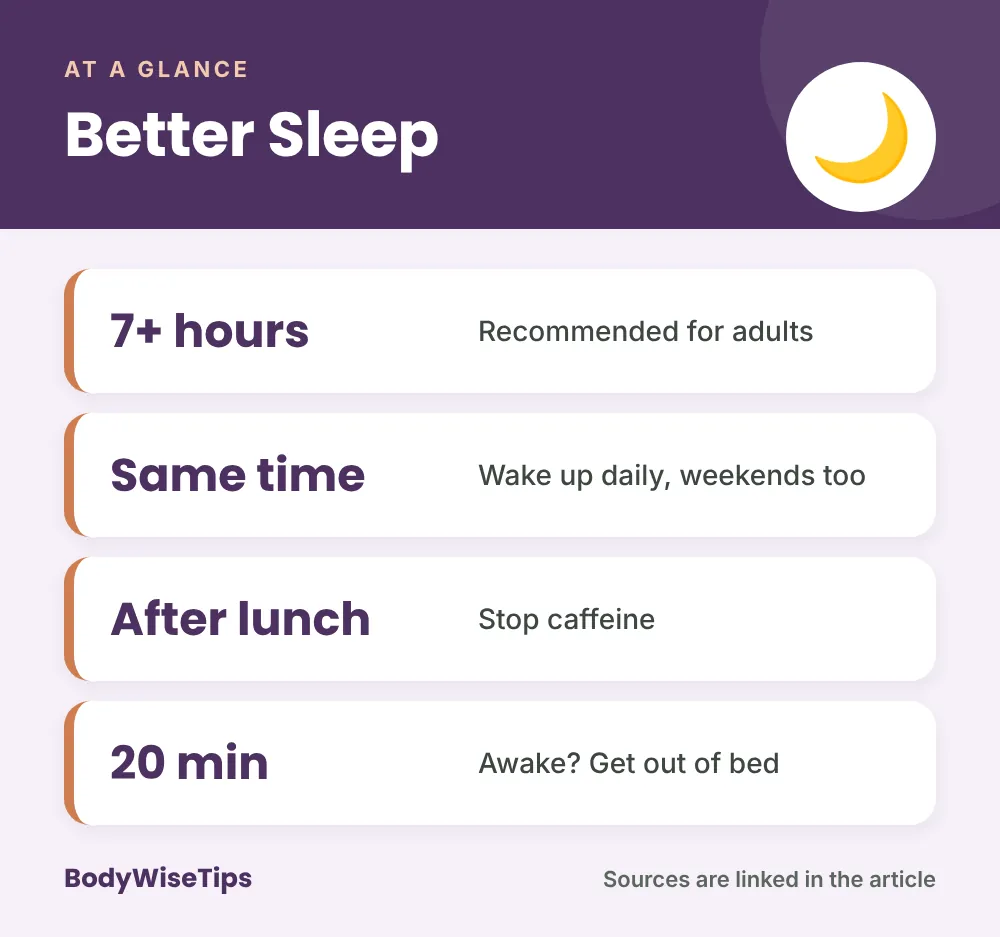
If that’s familiar, you’re far from alone. The CDC recommends at least seven hours of sleep for adults, and a large share of adults regularly get less.
The good news is that most sleep problems respond well to small changes in habits and environment. Here are twelve that have real evidence behind them.
Key takeaways
- A fixed wake-up time and morning daylight do more for sleep than anything you take at night.
- Stop caffeine after lunch and don’t count on alcohol to help you sleep.
- Awake for 20 minutes? Get up, do something calm in dim light, then try again.
In this article
Part 1: Set your body clock
1. Wake up at the same time every day
This is the most powerful habit on the list, and it’s about your wake time, not your bedtime. Your internal clock anchors to when you get up. A consistent wake time, including weekends, makes it easier to feel sleepy at the same time each night. Sleeping in for three hours on Sunday is basically giving yourself jet lag before Monday.
2. Get daylight in the morning
Bright light early in the day tells your brain it’s daytime, which helps set the timing of melatonin release later that night. Try to get outside for 10 to 20 minutes within an hour or so of waking. Even a cloudy day outdoors is far brighter than indoor lighting.
3. Dim the lights in the evening
Light at night, especially from screens and bright overhead bulbs, can delay your body’s release of melatonin. Harvard Health explains that blue light suppresses melatonin more strongly than other kinds of light. In the last hour before bed, switch to warm, low lamps and turn screen brightness down or, better, put the phone away.
Part 2: Watch what you eat and drink
4. Cut caffeine after lunch
Caffeine blocks adenosine, the chemical that builds “sleep pressure” during the day, and its effects last for hours. A cup at 4 p.m. can still be active at bedtime. The FDA suggests most healthy adults stay under 400 mg a day (about four cups of brewed coffee), but sensitive sleepers often do best with none after noon. Remember that tea, cola, energy drinks and chocolate count too.
5. Don’t rely on alcohol to fall asleep
A drink might make you drowsy, but alcohol fragments sleep in the second half of the night and reduces deep, restorative sleep. It’s one of the common reasons people wake up at 3am.
6. Finish big meals two to three hours before bed
Lying down with a full stomach can cause heartburn and discomfort. If you’re hungry later, a small snack like a banana, yogurt or a handful of nuts is fine.
Part 3: Make your bedroom work for you
7. Keep it cool, dark and quiet
Most people sleep best in a slightly cool room. The Sleep Foundation suggests around 65°F (about 18°C), adjusted to what feels comfortable for you. Use blackout curtains or an eye mask, and earplugs or a fan if noise is a problem.
8. Use the bed only for sleep
If you work, scroll and watch shows in bed, your brain starts to treat it as a place for being alert. Keeping the bed for sleep (and intimacy) helps re-link it with sleep.
9. If you can’t sleep after about 20 minutes, get up
This feels backward, but it’s a core part of cognitive behavioral therapy for insomnia (CBT-I), the treatment most sleep specialists recommend first. Go to another dim room, do something calm like reading a paper book, and come back when you feel sleepy. Lying in bed frustrated teaches your brain that bed equals stress.
Part 4: Calm a busy mind
10. Build a 30-minute wind-down routine
Do the same calm things in the same order each night: a shower, light stretching, prayer or a few pages of a book. Over time, the routine itself becomes a signal that sleep is coming.
11. Park your worries on paper
If your mind races at night, try writing tomorrow’s to-do list an hour or so before bed. Getting tasks out of your head and onto paper can make it easier to let go of them.
12. Try slow breathing
Slowing your breathing, with a longer exhale than inhale, can shift your body toward a calmer state. One simple pattern: breathe in through your nose for 4 counts and out slowly for 6 to 8 counts, for a few minutes. It won’t knock you out like a switch, but it helps many people relax enough to drift off.
What about sleep supplements?
Some people find supplements helpful for short-term use, but they aren’t risk-free and they don’t fix the habits above. Check with a pharmacist or doctor first, especially if you’re pregnant, breastfeeding, giving them to a child, or taking other medicines (particularly sedatives, antidepressants or blood thinners).
| Supplement | What to know |
|---|---|
| Melatonin | Most useful for jet lag and shifted body clocks. Low doses (0.5 to 3 mg) are often enough. Product strength can vary widely. See NCCIH. |
| Magnesium | May help people who are low in it. See our guide to magnesium glycinate for sleep. Avoid if you have kidney disease unless your doctor approves. |
| Valerian, chamomile | Mixed evidence. Can cause drowsiness the next day. Chamomile may trigger allergy in people sensitive to ragweed. |
| Ashwagandha | Some studies on stress and sleep, but rare cases of liver injury have been reported. Not for pregnancy. |
When to see a doctor
Talk to a doctor if poor sleep lasts more than three months, affects your work or mood, or comes with:
- Loud snoring, gasping or pauses in breathing at night (possible sleep apnea).
- Strong urges to move your legs in the evening (possible restless legs syndrome).
- Falling asleep during the day in situations like driving.
The NHS and the Mayo Clinic both describe CBT-I as an effective long-term treatment for insomnia, usually more effective over time than sleeping pills.
Pick two tips and start tonight
Better sleep usually comes from a handful of boring habits done consistently: the same wake time, morning light, less caffeine and alcohol, a cool dark room, and a calm routine before bed. Pick two or three tips from this list, try them for two weeks, and add more once they feel automatic.
Sources
- About Sleep, Centers for Disease Control and Prevention.
- Blue light has a dark side, Harvard Health Publishing.
- Spilling the Beans: How Much Caffeine is Too Much?, U.S. Food and Drug Administration.
- Sleep Hygiene, Sleep Foundation.
- Melatonin: What You Need To Know, National Center for Complementary and Integrative Health.
- Insomnia, NHS.
- Insomnia: Symptoms and causes, Mayo Clinic.