
Ask almost anyone online which magnesium to take for sleep and you’ll get the same answer: glycinate. It has become the default recommendation, usually with a promise that it will have you asleep in minutes.
Some of that reputation is earned and some of it is marketing. Glycinate is a sensible choice, but mostly for a reason nobody advertises: it’s easy on your stomach.
Key takeaways
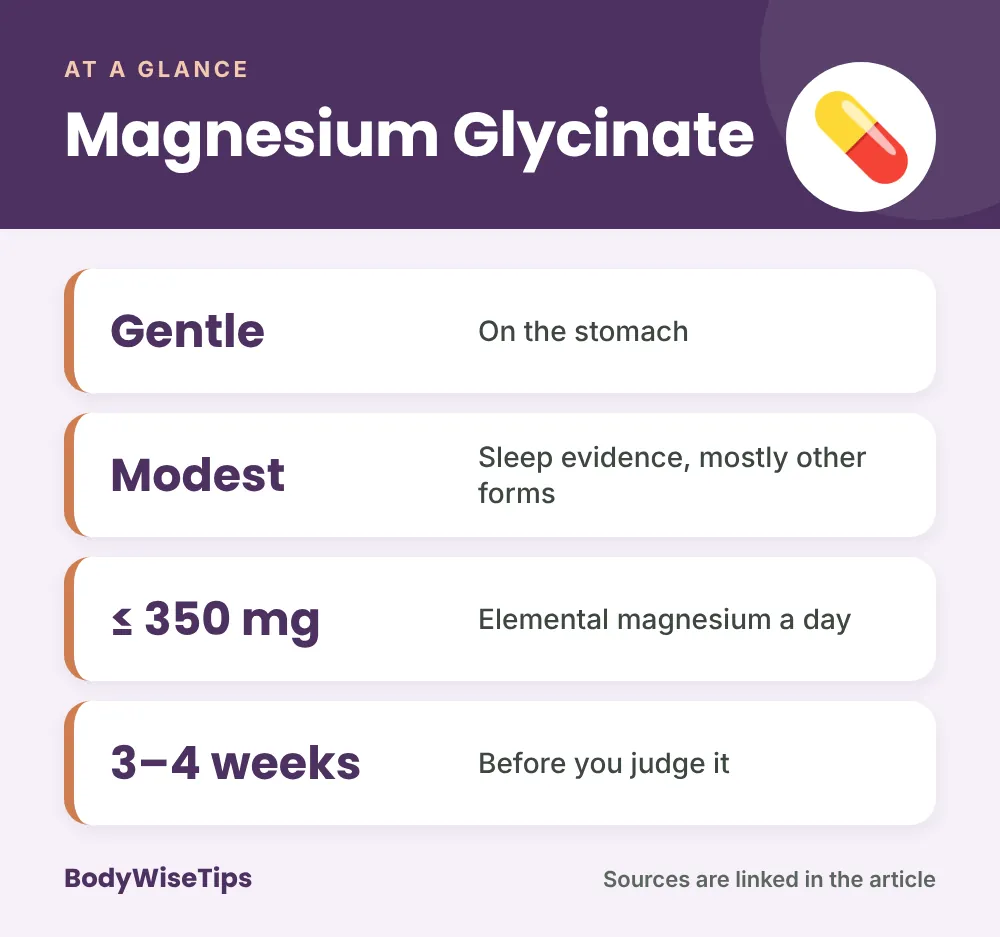
- Glycinate is gentle on the stomach, which is the main reason it is recommended.
- Almost no sleep studies tested glycinate itself. The evidence is for magnesium in general, and it is modest.
- Count elemental magnesium on the label and stay within 350 mg a day from supplements.
In this article
What magnesium glycinate is
It’s magnesium attached to glycine, an amino acid. You’ll also see it labeled “magnesium bisglycinate,” which is the same thing. Bonding magnesium to glycine makes a form that dissolves well and is gentle on the gut.
That matters because the most common complaint with magnesium supplements is diarrhea. Cheaper forms like magnesium oxide pull water into the bowel. Glycinate is far less likely to do that, so people can actually keep taking it.
What the research shows, and doesn’t
There’s an awkward gap here. Almost no sleep studies have tested magnesium glycinate specifically. The trials that exist mostly used other forms, such as magnesium oxide.
What we have instead are two separate lines of evidence:
- Magnesium in general. Small trials, mostly in older adults with insomnia, suggest modest improvements in sleep. A 2021 review of those trials concluded the evidence was low quality. The effect is most plausible in people whose intake is low, which is common according to the NIH Office of Dietary Supplements.
- Glycine on its own. A few small Japanese studies gave people 3 grams of glycine before bed and found they felt less tired the next day. A typical magnesium glycinate dose contains much less glycine than that, so you can’t assume the same result.
Put together: glycinate is a reasonable way to take magnesium, and magnesium may help sleep a little. Nobody has shown glycinate beats other forms for sleep. Anyone telling you otherwise is guessing.
Who is most likely to notice a difference
- People who eat few nuts, seeds, beans, whole grains and leafy greens.
- Older adults, who absorb less magnesium from food.
- People with type 2 diabetes or digestive conditions that affect absorption.
- People who get muscle cramps or restless legs at night. If that’s you, look at the other signs of magnesium deficiency too.
If your diet is already rich in magnesium and your sleep trouble comes from stress, a late phone habit or an irregular schedule, a supplement is unlikely to change much.
How much to take
- Stay at or under 350 mg of supplemental magnesium a day. That’s the adult upper limit set for supplements. It doesn’t include food.
- Read the label for “elemental magnesium.” Glycinate is bulky. A serving listed as “2,000 mg magnesium glycinate” often provides about 200 mg of actual magnesium. The elemental figure is the one to count.
- Start low. Try 100 to 200 mg for a week before increasing.
- Timing. Evening is convenient, about 30 to 60 minutes before bed. We go into this in the best time to take magnesium for sleep.
Side effects
Glycinate is the best tolerated form, but it isn’t side-effect free. Some people get loose stools, nausea or stomach cramps, especially at higher doses. A few report feeling groggy the next morning. If that happens, lower the dose or take it earlier in the evening.
Very high intakes of magnesium from supplements can cause low blood pressure, muscle weakness and an irregular heartbeat. This is rare and mostly happens in people whose kidneys can’t clear it.
Who should not take it without medical advice
- People with kidney disease.
- People taking antibiotics in the tetracycline or quinolone families, or bisphosphonates for osteoporosis. Magnesium blocks their absorption, so doses need to be spaced apart.
- People on diuretics, heart medicines or long-term acid reflux tablets.
- Women who are pregnant or breastfeeding.
- Children.
How to choose a product
Supplements aren’t checked the way medicines are, so quality varies. Three things help:
- Look for a third-party testing mark such as USP or NSF.
- Check that the label states elemental magnesium per serving.
- Avoid “buffered” blends if you want pure glycinate. Buffered products mix in cheaper magnesium oxide.
Glycinate compared with other forms
| Form | Absorption | Stomach | Typical use |
|---|---|---|---|
| Glycinate | Good | Gentle | Sleep, general top-up |
| Citrate | Good | Mild laxative | Top-up, constipation |
| Oxide | Lower | Often causes loose stools | Constipation, heartburn |
Food first
You can cover much of your need without a capsule. An ounce of pumpkin seeds has about 156 mg of magnesium and an ounce of almonds about 80 mg. Half a cup of cooked spinach has around 78 mg. Getting magnesium this way also brings fiber and other minerals, and there’s no upper limit for magnesium from food.
So, is it worth trying?
If your diet is low in magnesium and you want a gentle supplement, glycinate is a fair choice and reasonably safe for healthy adults. Give it three to four weeks and keep your expectations modest. If you still can’t sleep, the cause is probably elsewhere. Start with the habits in how to sleep better at night naturally, and see a doctor if poor sleep has lasted more than three months.
Quick questions
How long does magnesium glycinate take to work for sleep?
Some people feel calmer within days, but the studies on magnesium and sleep ran for several weeks. Judge it after about a month.
Can I take magnesium glycinate every night?
Most healthy adults can, within the 350 mg limit for supplements. Check first if you have kidney problems or take regular medication.
Is magnesium glycinate better than melatonin?
They do different things. Melatonin shifts the timing of your body clock and suits jet lag or a late sleep schedule. Magnesium tops up a mineral you may be short of. Neither treats long-term insomnia.
Sources
- Magnesium: Fact Sheet for Health Professionals, NIH Office of Dietary Supplements.
- Magnesium: Fact Sheet for Consumers, NIH Office of Dietary Supplements.
- Mah J, Pitre T. Oral magnesium supplementation for insomnia in older adults: a systematic review and meta-analysis. BMC Complementary Medicine and Therapies. 2021;21:125.
- Insomnia: Symptoms and causes, Mayo Clinic.