
Belly fat is the fat people most want gone and the fat with the most nonsense written about it. Teas, wraps, “one weird trick” videos and thousand-crunch challenges all promise to melt it.
None of them do. What works is slower and less exciting: a handful of habits kept up for months. The good part is that the fat around your middle responds well to them, often before the scale moves much.
Key takeaways
- You can’t spot-reduce belly fat. It shrinks as overall body fat comes down.
- Protein, fiber, fewer sugary drinks, strength training, daily walking and sleep do most of the work.
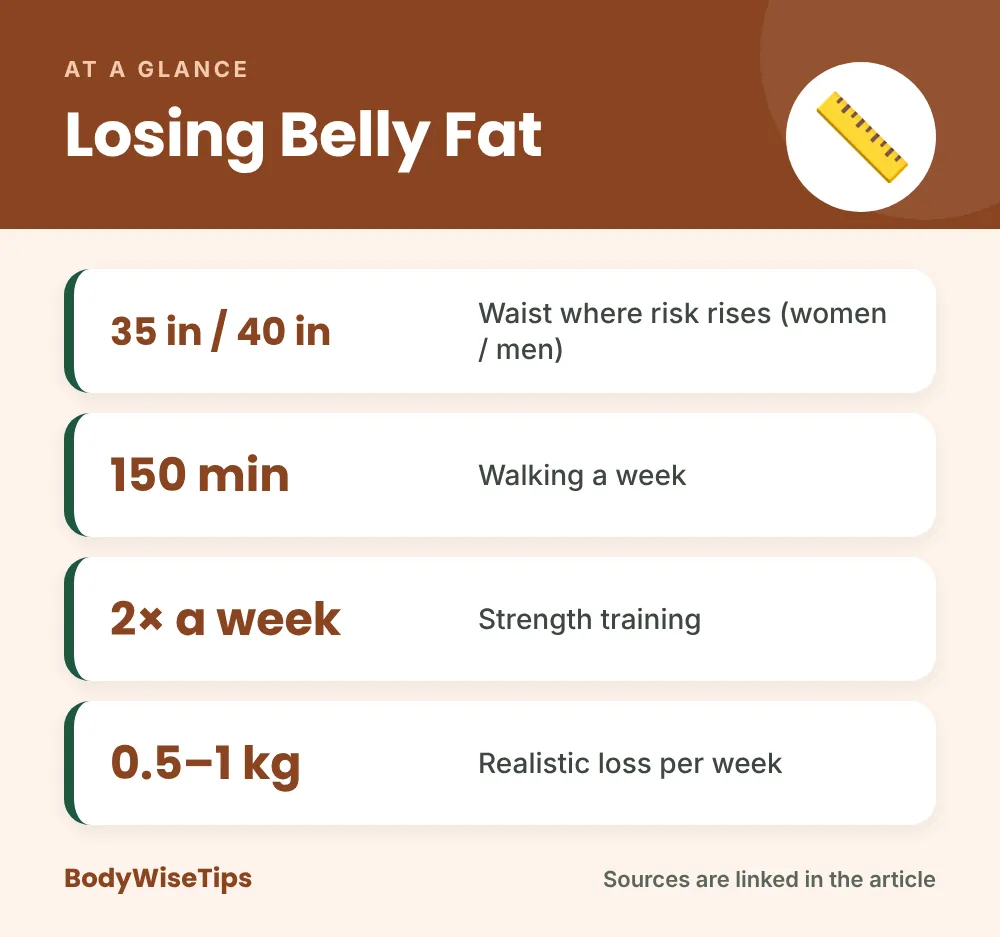
- Measure your waist every two weeks. Expect about 0.5 to 1 kg of loss a week.
In this article
Two kinds of belly fat
The soft fat you can pinch is subcutaneous fat. It sits under the skin and is mostly harmless.
The fat that matters for health is visceral fat, which sits deep in the abdomen around your organs. The Cleveland Clinic links too much of it to type 2 diabetes, heart disease and other conditions.
You can’t see visceral fat, but your waist gives a fair estimate. Measure just above your hip bones after breathing out. Risk goes up above 35 inches (88 cm) for women and 40 inches (102 cm) for men. Lower cut-offs are often used for people of South Asian descent, so ask your doctor which applies to you.
One thing to accept first
You can’t choose where your body loses fat. Ab exercises strengthen the muscle underneath, but the fat on top only goes as your overall body fat comes down. Everything below works on the whole body, and your waist benefits.
11 things that work
1. Eat more protein
Protein keeps you full longer than carbs or fat, and it protects muscle while you lose weight. Include a palm-sized portion at each meal: eggs, yogurt, chicken, fish, lentils, beans or tofu. Our guide on how much protein you need has the numbers.
2. Eat more fiber, especially soluble fiber
Soluble fiber forms a gel in the gut, slows digestion and helps you feel satisfied. In one observational study from Wake Forest, people who ate more soluble fiber gained less visceral fat over five years. Oats, beans, lentils, apples, citrus fruit and chia seeds are good sources. The Harvard Nutrition Source has a full list. Add it gradually so you don’t bloat.
3. Stop drinking your sugar
Soda, sweet tea, energy drinks and fruit juice add a lot of sugar without making you full. If you change one thing this month, swap these for water, sparkling water or unsweetened tea.
4. Cut back on refined carbs
White bread, pastries, sugary cereal and most packaged snacks digest fast and leave you hungry again. Swap some for oats, brown rice, whole-grain bread, beans and potatoes with the skin on. You don’t need to cut carbs out.
5. Lift weights twice a week
Strength training builds and protects muscle, and muscle improves how your body handles blood sugar. Squats, push-ups, rows and lunges are enough. The CDC recommends muscle-strengthening activity on at least two days a week.
6. Walk every day
Aerobic exercise is consistently linked to less visceral fat, even when body weight barely changes. You don’t have to run. Aim for 150 minutes a week of brisk walking, which is about 22 minutes a day. If you want something more structured, try Japanese interval walking.
7. Sleep at least seven hours
Short sleep raises your hunger hormones and makes high-calorie food harder to resist. The National Heart, Lung, and Blood Institute links ongoing sleep loss to a higher risk of obesity. See how to sleep better at night naturally.
8. Deal with long-term stress
Stress pushes people toward comfort food and away from exercise, and long-term high cortisol favors fat storage around the middle. A daily walk, time outside and ten quiet minutes without your phone all help. More in our article on cortisol and belly fat.
9. Drink less alcohol
Alcohol brings calories with no fullness, lowers your guard around food and disturbs sleep. You don’t have to quit, but cutting down is one of the faster ways to see a change at the waist.
10. Cook more of your own meals
Restaurant and packaged food is designed to be easy to overeat. When you cook, you control the oil, sugar and portion. Even three more home-cooked dinners a week makes a difference.
11. Be patient and measure the right thing
A realistic pace is about 0.5 to 1 kg (1 to 2 lb) a week. Measure your waist every two weeks instead of weighing yourself daily. If you’re gaining muscle, your waist can shrink while the scale stays put.
What doesn’t work
- Detox teas and fat-burner pills. No good evidence, and some have caused harm.
- Waist trainers and sweat belts. You lose water, which comes straight back.
- Endless crunches. Good for your abs, no effect on the fat covering them.
- Crash diets. You lose muscle as well as fat, and the weight usually returns.
A simple day that covers most of this
- Breakfast: oats with yogurt, berries and chia seeds
- Lunch: chicken or chickpea salad with whole-grain bread
- Snack: an apple and a handful of nuts
- Dinner: fish or lentils with vegetables and brown rice
- Movement: a 25-minute walk, plus strength exercises on two days
When to see a doctor
Speak to a doctor if your waist is growing quickly without a change in habits, if you’re gaining weight despite real effort, or if you have other symptoms such as extreme tiredness, irregular periods or very high thirst. Thyroid problems, polycystic ovary syndrome, insulin resistance and some medicines can all cause weight gain around the middle.
Where to start
Pick two things from the list and do them for a month. For most people the best first pair is swapping sugary drinks for water and walking every day. Add protein at each meal next, then strength training. Give it three months before judging, and measure your waist, not your mood on the scale.
FAQ
How long does it take to lose belly fat?
Most people notice a difference in how clothes fit within four to eight weeks of consistent changes. Visible change takes longer and varies a lot between people.
Does apple cider vinegar burn belly fat?
A few small studies suggest tiny effects on weight, nowhere near what the internet claims. It won’t make up for diet and activity, and it can irritate your throat and teeth.
Can I lose belly fat without exercise?
You can lose fat through diet alone, but exercise helps you keep muscle and specifically reduces visceral fat, so the combination works best.
Sources
- Visceral Fat, Cleveland Clinic.
- Fiber, The Nutrition Source, Harvard T.H. Chan School of Public Health.
- Adult Activity: An Overview, Centers for Disease Control and Prevention.
- Sleep Deprivation and Deficiency, National Heart, Lung, and Blood Institute.
- Hairston KG, et al. Lifestyle factors and 5-year abdominal fat accumulation in a minority cohort: the IRAS Family Study. Obesity. 2012;20(2):421-427.