You did what you were told. You went to bed on time, slept eight hours, and woke up feeling like you’d had four. By mid-afternoon you’re reaching for coffee again and wondering what’s wrong with you.
Usually nothing dramatic. Hours in bed and good sleep aren’t the same thing, and several ordinary health issues cause tiredness that no amount of sleep fixes. This guide walks through the likely causes, starting with the most common.
Key takeaways
- Eight hours in bed is not the same as eight hours of good sleep.
- Alcohol, late caffeine, an irregular schedule and sleep apnea are common sleep-side causes.
- Low iron, thyroid problems and low vitamin D or B12 cause tiredness that sleep won’t fix. A blood test can check.
In this article
First, is it the sleep or is it you?
A quick way to sort it out: think about how you feel 30 to 60 minutes after getting up.
- Groggy at first, then fine. That’s sleep inertia, the normal fog as your brain switches on. It’s worse if an alarm pulls you out of deep sleep.
- Tired all day, every day. Either your sleep is poorer than it looks, or something else is draining you.
Reasons your sleep isn’t doing its job
Your sleep is broken up
You can be in bed for eight hours and wake briefly dozens of times without remembering. Noise, a warm room, a partner who moves, a pet on the bed and a phone that lights up all chip away at deep sleep. The Sleep Foundation recommends a cool, dark, quiet bedroom for this reason.
Alcohol in the evening
A drink helps you fall asleep and then wrecks the second half of the night. Sleep gets lighter and more broken as your body clears the alcohol. If you often wake in the early hours, read why you wake up at 3am.
Caffeine that’s still in your system
Caffeine lasts for hours. An afternoon coffee may not stop you falling asleep, but it can make your sleep shallower. Try nothing after lunch for two weeks and see.
An irregular schedule
Sleeping from midnight to eight on weekdays and 2 a.m. to 10 at weekends gives your body clock the equivalent of jet lag every Monday. A steady wake-up time matters more than a steady bedtime.
Sleep apnea
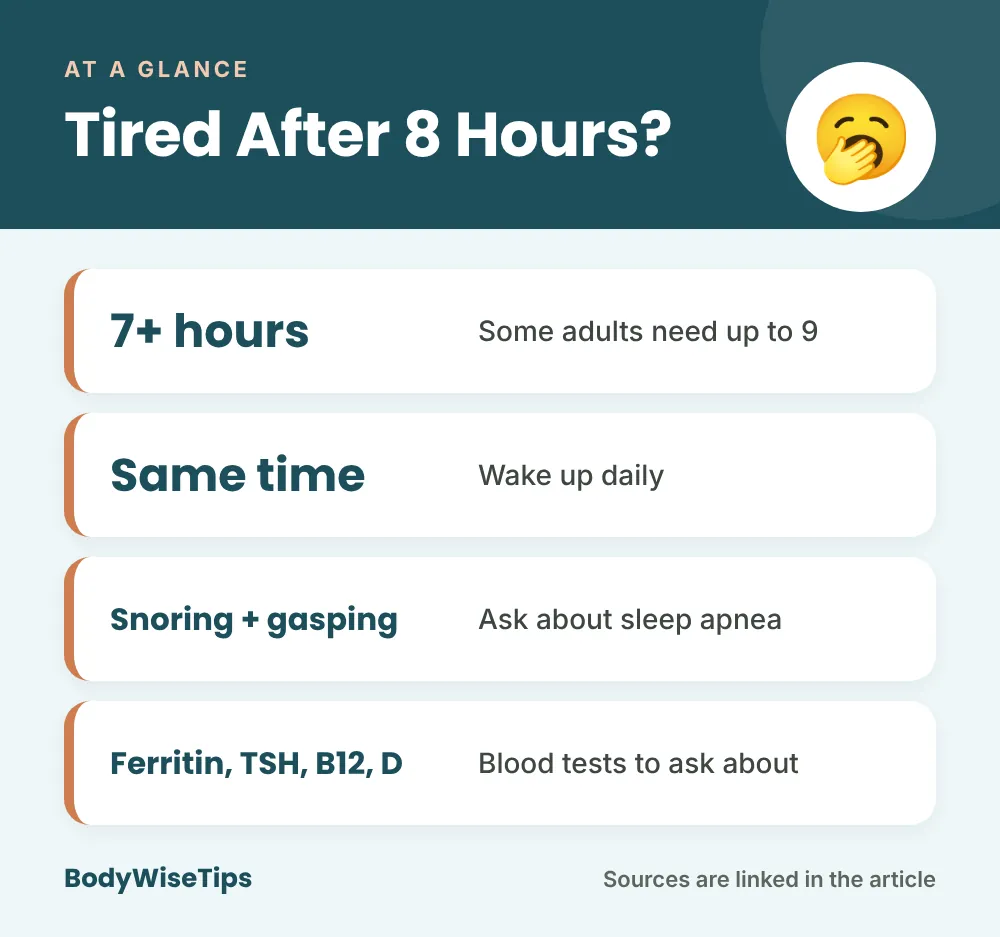
In obstructive sleep apnea, your airway narrows or closes again and again during sleep, and each time your brain wakes you just enough to breathe. You don’t remember it. You just feel exhausted. The Mayo Clinic lists loud snoring, gasping or choking at night, morning headaches and daytime sleepiness as the main signs. It’s common, underdiagnosed and treatable, and it’s worth asking about if a partner has noticed you snore or stop breathing.
You need more than eight hours
Eight is an average. The CDC recommends at least seven hours for adults, and some people need nine. Teenagers need more still. If you feel great on holiday after a week of nine-hour nights, that’s a clue.
Health reasons that sleep won’t fix
Low iron
One of the most common causes of ongoing tiredness, especially in women with periods. You can have low iron stores without being anemic. Other clues are breathlessness on the stairs, pale skin, hair shedding and cold hands. The NHS lists tiredness and lack of energy as the main symptoms. A blood test for ferritin settles it. More in our guide to low iron and fatigue.
An underactive thyroid
When your thyroid makes too little hormone, everything slows. Tiredness comes with feeling cold, weight gain, dry skin and constipation. It’s diagnosed with a simple blood test.
Low vitamin D or B12
Both can cause fatigue. Low vitamin D is more likely if you have darker skin, cover up outdoors or spend most of your day inside, according to the NIH. Low B12 is more common in vegans, older adults and people taking metformin or long-term acid reflux medicine.
Blood sugar problems
Undiagnosed diabetes and prediabetes can both cause tiredness, often with increased thirst and needing to pee more. See our guide to the early signs of insulin resistance.
Depression and anxiety
Low mood often shows up as exhaustion before it shows up as sadness. If you’ve also lost interest in things you used to enjoy, or you feel flat or on edge most days, talk to a doctor.
Medicines
Antihistamines, some blood pressure tablets, some antidepressants and sedating pain medicines can all cause daytime drowsiness. Don’t stop a prescribed medicine yourself. Ask your doctor or pharmacist whether a different drug or a different time of day would help.
Not moving enough
It sounds backwards, but people who sit most of the day tend to feel more tired. Regular activity improves both energy and sleep quality. A daily 20-minute walk is enough to start.
A two-week reset to try first
Before booking tests, give these a fair trial:
- Get up at the same time every day, weekends included.
- Go outside for 10 to 20 minutes of daylight soon after waking.
- No caffeine after lunch.
- No alcohol within three to four hours of bed, or skip it entirely for the two weeks.
- Keep the bedroom cool and dark, and leave your phone outside it.
- Walk for at least 20 minutes a day.
Our full guide on how to sleep better at night naturally has more detail on each step.
When to see a doctor
Make an appointment if the tiredness has lasted more than a few weeks despite decent sleep habits, or if you have any of these:
- Loud snoring, gasping or pauses in breathing at night
- Falling asleep while driving or in meetings
- Heavy periods, breathlessness or pale skin
- Unexplained weight loss or gain
- Low mood or loss of interest lasting two weeks or more
- Constant thirst and frequent urination
Useful tests to ask about are a full blood count, ferritin, thyroid function (TSH), vitamin B12, vitamin D and blood sugar (HbA1c).
What to take from this
Being tired after eight hours usually comes down to one of two things: sleep that’s more broken than you realize, or a health issue such as low iron, a slow thyroid or sleep apnea. Tidy up the obvious sleep habits for two weeks. If you’re still dragging, it’s time for a blood test and an honest conversation with a doctor, not another supplement.
Questions people ask
Why am I more tired when I sleep longer?
Sleeping much later than usual shifts your body clock, and waking from deep sleep makes you groggy. A consistent wake-up time usually feels better than a long lie-in.
Can dehydration make you tired in the morning?
Mild dehydration can add to tiredness and headaches. A glass of water after waking is a reasonable habit, but it rarely explains fatigue that lasts all day.
How do I know if I have sleep apnea?
You can’t confirm it yourself. Loud snoring, witnessed pauses in breathing and daytime sleepiness are the main warning signs. A doctor can arrange a sleep study, which is often done at home.
Sources
- About Sleep, Centers for Disease Control and Prevention.
- Sleep Hygiene, Sleep Foundation.
- Obstructive sleep apnea: Symptoms and causes, Mayo Clinic.
- Iron deficiency anaemia, NHS.
- Vitamin D: Fact Sheet for Health Professionals, NIH Office of Dietary Supplements.
- Sleep Deprivation and Deficiency, National Heart, Lung, and Blood Institute.